A five-page Jobber template, rebuilt as a 360-page site for a junk removal and land-clearing crew
Big Rob's Hauling earned 118 five-star Google reviews in its first year, and its website showed a count of 90. We replaced a five-page template with 360 indexable pages, English and Spanish, built from the company's own photos, prices and reviews.
Big Rob's Hauling · Davenport, FL · Central Florida · Launched September 2026 · Visit the live site
The business
Big Rob's Hauling
Big Rob's Hauling is a family-run junk removal company that started in 2025. It does five kinds of work: junk removal, dump trailer rentals, property cleanouts, small demolition, and land clearing with its own machines. Based in Davenport, FL, it covers 40 towns across Polk, Osceola, Lake, Orange and Hillsborough counties and is open 24 hours.
The reviews carried the business. 119 Google reviews in the first year, 118 of them five-star, and they say the same things over and over: fast arrival, a flat rate quoted up front and held, help loading, clean-up after. The old website said almost none of that.
The old site
What they had before.
Front end: what customers saw
- Template copy
- The four service pages were Jobber template pages. The headings read like "Expert Junk Removal Services in the Local Area", with no town or county in any of them.
- Reviews
- The review widget was stuck at 90 reviews when the Google profile had 118. The strongest thing the business had was undercounted on its own site.
- Pricing and sizes
- No price signal anywhere, no dump trailer sizes, and no list of what they take. A customer couldn't tell what a load cost or which trailer to rent.
- About
- The about section was a heading and one image. No copy about who runs the jobs or that it is a family business.
- Navigation
- The nav had Home and Client Login. No way to browse by service or by town.
- Services missing or wrong
- Land clearing, a core service on the Facebook page and Google profile, had no page. One page was a generic eco-friendly and hazardous disposal template with no actual service behind it.
Back end: what Google and AI saw
- Platform
- The site ran on Jobber's website builder with a "Powered by Jobber" footer. Five URLs total: the home page and four service pages. Everything else answered 404.
- FAQ hidden from crawlers
- The FAQ accordions rendered the questions only. The answer text never reached the page HTML, so search engines and AI tools had nothing to read or quote.
- Meta tags
- The meta keywords tag was stuffed with 20 phrases. Search engines ignore that tag, and it looks spammy to anyone who checks.
- No local pages
- The service area was a bare list of 12 town names with no pages behind them. There was nothing for a town-level search to land on.
- Search visibility
- Twelve months of the old site's Search Console data showed branded searches doing most of the work. The non-branded footprint was tiny, and the one thin dump-trailer page sat around position 33 for a local dumpster rental search.
- Quote requests
- Quote requests went through Jobber's embedded request forms, hosted on Jobber's client hub rather than on the site itself.
What we built
The new site, piece by piece.
What the 360 pages include
- 5Service hubs
- 39Service
- 11Decision guides
- 40Town
- 5County
- 68Service-by-town
- 99Job-by-town
- 40Blog
- 25Disposal & permit guides
- 17Spanish
Structure
360 indexable pages: 5 service hubs, 39 service pages, 11 side-by-side decision guides, 40 town pages, 5 county pages, 68 service-by-town pages, 99 job-by-town pages, 40 blog posts, 25 disposal and permit guides, and 17 Spanish pages. Every town and service-by-town page had to carry at least three facts specific to that page and pass a duplicate-content check, or it was not built.
Design
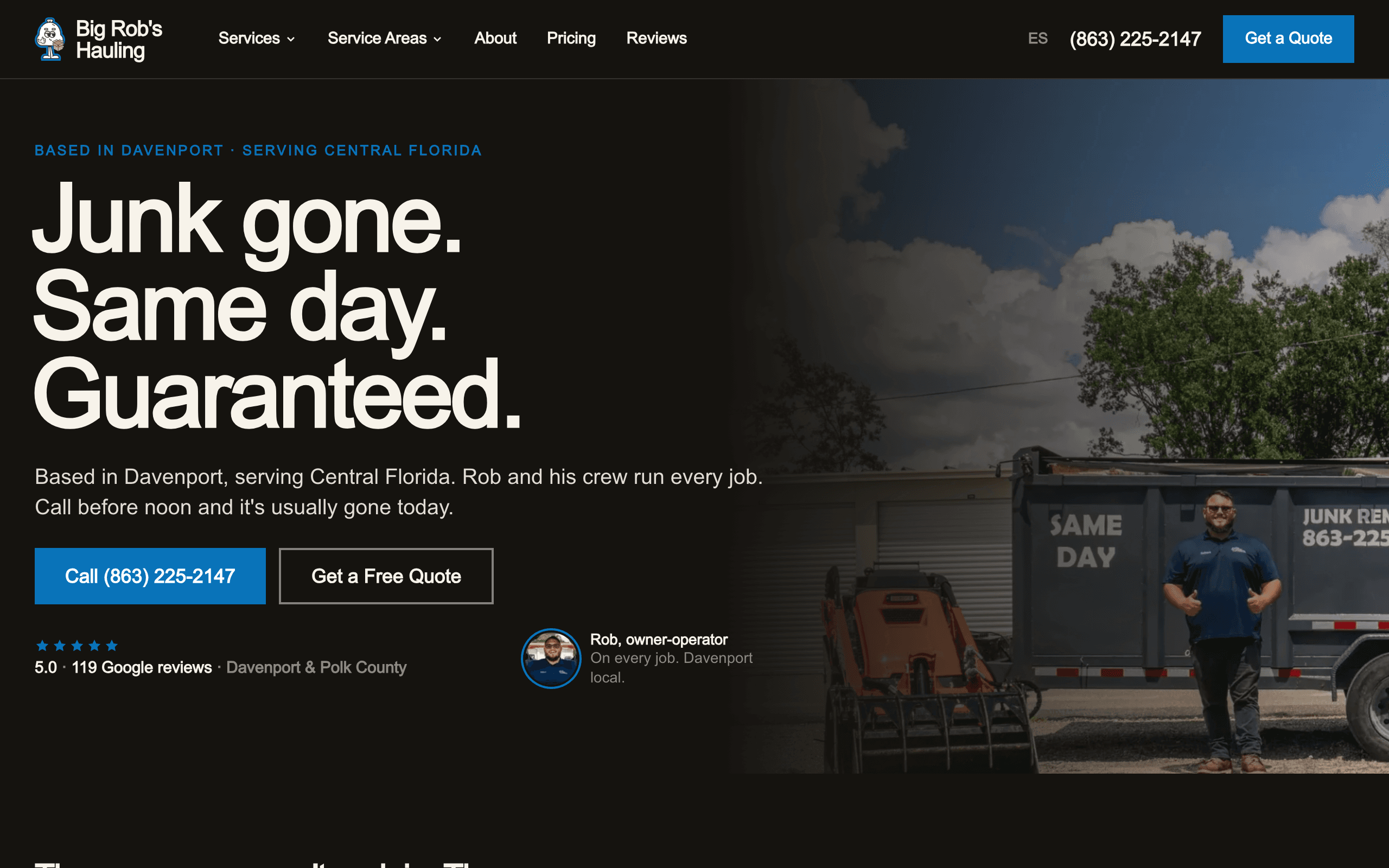
Warm dark and light sections, one variable typeface, and one accent color sampled from the company's own logo. The hero is the company's tagline, "Junk gone. Same day. Guaranteed.", set big over a real job photo. Every photo is from the company's own jobs and social accounts. No stock.
Built for the phone
On mobile the header is logo and menu only, and a sticky bar at the bottom carries call and quote on every page. The menu sheet pins its own call and quote buttons, so an open menu never hides the only way to reach them.
Proof from real reviews
A strip on the home page lays out arrival times pulled word for word from Google reviews: 20 minutes, 35 minutes, same day. The review count comes from one data file, and the build fails if any page or schema node shows a different number.
Prices on the page
The flat-rate ladder is published: $125 single item as the job minimum, up through quarter, half, three-quarter and full trailer at $700, with hourly labor as its own line. Item pages start from the job minimum and say plainly that access, stairs, size and volume set the final number.
Quote form and follow-up
The form posts to the site's own server, which emails the lead to the business inbox with the customer's email as reply-to. Once that send succeeds, the customer gets a confirmation email, in Spanish if they used the Spanish form, and the business copy is flagged as a Spanish-language lead. On phones, a text-a-photo button sits next to the form for photo quotes.
Tracking
Google Tag Manager loads site-wide, and Microsoft Clarity records sessions. The form pushes one lead event, and only after the lead email actually sent, so spam and failed sends never count. Call and text taps push their own events, no name, phone or email ever goes into the data layer, and a paid click's ID is kept for 90 days and written into the lead email.
Schema
LocalBusiness, Organization, WebSite, Service with price ranges, FAQPage, BreadcrumbList, BlogPosting, and 25 Review nodes with an AggregateRating. Every service names each county and town it covers, and a schema check runs on every build.
AI search
robots.txt explicitly allows GPTBot, ClaudeBot, PerplexityBot, Google-Extended, Applebot-Extended, CCBot and Bingbot. An llms.txt file gives AI tools a plain-text business record: services, service area, contact, hours and pricing model. FAQ answers are in the page HTML, and Clarity tags visits that arrive from AI assistants.
Old links kept
Every old service URL 301s in one hop to its new hub, with query strings kept. The build fails if any redirect chains or lands on a 404.
Old vs new
Side by side.
| Old site | New site | |
|---|---|---|
| Platform | Jobber website builder template | Custom Next.js site on Vercel |
| Indexable pages | 5 | 360 |
| Town and county pages | None (a list of 12 town names) | 40 town pages and 5 county pages |
| Spanish pages | None | 17, with a Spanish quote form |
| FAQ answers in the HTML | No, questions only | Yes, with FAQPage schema |
| Review count shown | 90 (profile had 118) | 119, checked against the Google profile on every build |
| Pricing shown | None | Flat-rate ladder from a $125 job minimum |
| Quote requests | Jobber embedded request forms | On-site form: lead emailed to the business, confirmation sent to the customer in their language |
How a build like this runs, start to finish: See how we work →